Subterranean termites represent the primary wood-destroying insect threat across Franklin County, where seasonal spring swarms frequently emerge after early April precipitation. In historic districts featuring heavy…
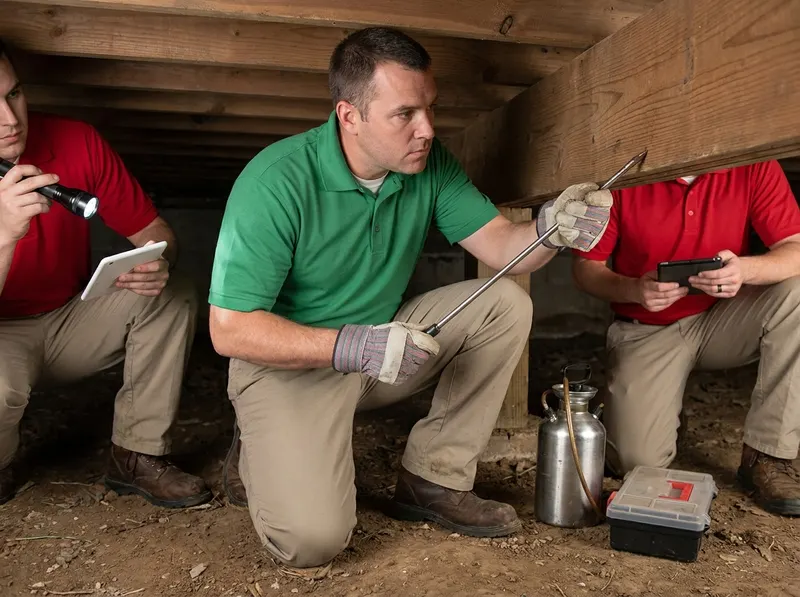
Subterranean termites represent the primary wood-destroying insect threat across Franklin County, where seasonal spring swarms frequently emerge after early April precipitation. In historic districts featuring heavy timber framing, such as brick-foundation basements in German Village, fieldstone basements in Victorian Village, and crawl spaces in Clintonville, colonies exploit subterranean pathways through hairline mortar cracks as narrow as 1/32 of an inch. Columbus structures built with earth-to-wood contact or moisture retention near exterior sill plates require systematic non-destructive diagnostics rather than uncalibrated synthetic pesticide flooding. Diagnostic assessments evaluate cellulose consumption levels using directional acoustic sensors and calibrated moisture meters compliant with standards recognized by the US EPA and the Ohio Department of Agriculture Plant Health Division, confirming whether subterranean worker galleries have penetrated structural floor joists.
Selecting the proper treatment protocol depends on architectural foundation construction and groundwater proximity. Exterior perimeter baiting systems serve properties adjacent to waterways like the Scioto River near Franklinton or the Olentangy River corridor in Upper Arlington, intercepting foraging workers using insect growth regulators without introducing persistent chemical barriers into surrounding loam soil. Conversely, targeted non-repellent liquid applications conform to structural footings where stone or slab foundations show localized mud tubes. The structural trade-off centers on time to total colony mortality versus foundation alteration: liquid applications establish immediate perimeter protection within 48 hours, whereas bait stations require 60 to 120 days to achieve full biological colony elimination through trophallaxis while avoiding invasive indoor drilling through finished hardwood flooring or tiled slab entries in Bexley and Grandview Heights homes.
Remediation protocols proceed through distinct execution phases designed to protect indoor air quality and structural integrity:
Regional building ages substantially dictate subterranean termite behaviors throughout Central Ohio. In neighborhoods with mature urban tree canopies like Olde Towne East and Worthington Hills, subterranean colonies frequently nest in subterranean root systems of dead silver maples before migrating toward structural mud sills. Ensuring exterior wood siding maintains a clear 6-inch clearance from soil grades prevents concealed subterranean access, as documented by Ohio State University Extension entomology research and U.S. Department of Housing and Urban Development residential preservation guidelines. Structural assessments also align with building safety guidance from the International Code Council, property valuation protocols from the Appraisal Institute, foundational moisture standards from the ASHRAE Society, environmental benchmarks from the Clean Water Action Alliance, and biological handling practices outlined by the Entomological Society of America. Homeowners experiencing active swarmers or interior mud shelter tubes may reach TerraBloom Extermination by calling (380) 255-6029.
Every job gets a firm, written price after an on-site visit.
Tell us about your termite inspection and eradication job in Columbus and we'll send a clear, written quote, usually the same day.
 TerraBloom Extermination